Method
qPCR — CORE-ABR molecular panel
Real-time polymerase chain reaction
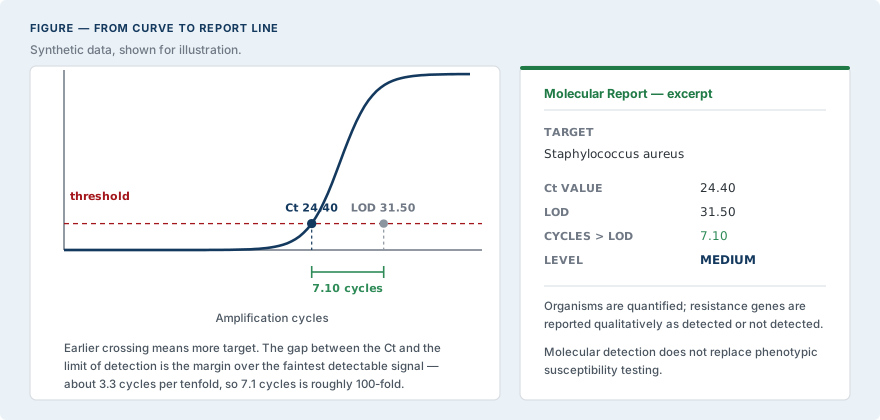
Organisms are detected and quantified; resistance genes are reported qualitatively as detected or not detected. Reports are generated by CORE-ABR, which applies organism-aware antibiotic ranking incorporating intrinsic biology, detected resistance genes, and site-specific rules.
Orderable panels 6
- Genotyping — MTHFR + COMT components bill separately
A genotype describes enzyme capacity, not a clinical state. It is fixed at birth, identical on every specimen, and does not change with treatment, diet or time — so it says something about the machinery, not about what the machinery is currently doing. Both variants are common in the general population, and carrying one is not itself a finding. Where the question is what methylation is actually doing, the measurements answer it: homocysteine, folate and vitamin B-12, all of which Clinicore runs. A genotype can inform how those results are read; it does not substitute for them.
- Wound panel components bill separately
Molecular detection in wound specimens recovers colonizing organisms as well as pathogens. Reports characterize colonizer likelihood. Molecular detection does not replace phenotypic susceptibility testing.
- STI / STD profile components bill separately
- Basic UTI profile components bill separately
Molecular detection in urine specimens recovers colonizing organisms as well as pathogens.
- Complete Care UTI / STI components bill separately
- Antibiotic resistance profile components bill separately
Detection of a resistance gene predicts resistance. Absence of a detected gene does NOT establish susceptibility — resistance arises through mechanisms outside the target set, including efflux and porin changes. Molecular detection does not replace phenotypic susceptibility testing.
Every test in this line
The catalog lists all 0 analytes with method, specimen, codes, and reportable range or cutoff.
Browse the molecular testing catalog